

The AI Lessons We Don't Get to Choose: A Series of AI-in-Education Thoughtpieces by Heath Dingwell

One of the most important AI lessons may not be how to use the tool. It may be how to live with a decision someone else already made.
AI literacy is the phrase institutions use for training meant to prepare people for AI: what it can do, what it gets wrong, how to use it, when to trust it, and when to push back.
The trouble is that this phrase can cover very different agendas. A lesson can help someone make a better call, or it can make adoption feel inevitable. It can give people language to question a system, or train them to move faster inside one.
This issue looks at the training now being built around AI, not just the tools themselves. The stakes are in who defines the lesson, what the training measures, and whether people leave with more judgment and agency or just a cleaner path to adoption.

When the AI Policy Lands on the Teacher’s Desk
AI policy sounds like a set of rules a district writes down. In practice, it can become one teacher deciding what to do with one student’s work: whether a chatbot helped or replaced the thinking, whether a school-approved tool can be trusted, and what happens if the tool is wrong. For a small district already short on staff, that is too much to leave to each classroom.
Montana is trying to answer that problem at the state level. The Montana Digital Academy, or MTDA, which the state legislature created in 2009 to support online learning, has opened the Frontier Learning Lab at the University of Montana. The lab runs AI training events in schools, operates an AI help desk, and works with districts on questions that individual teachers are already facing: student privacy, cheating, assessment, and whether any classroom AI tool is appropriate for children.
The AI role is not one magic classroom product. It’s a support system around the tools. The lab has graduated its first cohort of 20 teachers trained in AI so they can become resources for their districts, and public schools are using two MTDA-supported tools: SchoolAI, a school-facing chatbot platform, and TrueMark, a monitored writing tool that the article describes as diagnosing whether an assignment was completed by a student or AI.
Those decisions get complicated quickly. A teacher may be facing a student essay that looks too polished, a chatbot a student wants to use for feedback, a parent asking what is allowed, and a district tool that promises to verify authenticity. A teacher still has to decide what happens next: when AI help is allowed, how to preserve learning, what evidence is enough to raise an integrity concern, and when a tool’s answer should not be trusted. The lab’s role is to give districts shared guidance for those decisions, rather than leaving every teacher to invent a rule alone.
Montana’s remote-learning history makes the story more than an AI policy experiment. The same academy already helps schools offer courses they might not otherwise be able to staff, including Indigenous language classes. Montana had 850 teacher openings listed on the state Office of Public Instruction job board when the article was published in April 2026, down from 1,000 in 2023. In a state with long distances and uneven staffing, a shared AI training and support layer can matter because the alternative is not a well-funded local AI team. It may be one teacher trying to figure it out alone.
None of this proves the lab is working yet. The article doesn’t show whether the Frontier Learning Lab improves student learning, reduces teacher workload, prevents cheating, protects privacy, or makes assessment fairer. The more than 90% student satisfaction figure applies to Montana Digital Academy courses generally, not to the AI lab.
The tool-vetting problem is especially important with TrueMark. The article describes it as diagnosing whether an assignment was completed by a student or AI, but AI writing detection tools have a poor track record. A district using a system like that would need to track when it is right, when it is wrong, who is affected, how appeals work, and whether teachers get better information or just another source of suspicion. Many districts may not have the staff, data capacity, or budget to do that well.
Montana is not just telling teachers to become AI literate. It is starting to define what AI literacy means in school: safe use, teacher support, guarded tools, and shared expertise for districts with fewer resources. The next test is whether that support becomes more than training attendance and tool access. Schools should be able to show whether teachers make better decisions, students get clearer rules, and classrooms get less confusing rather than just more monitored.

The Diploma Now Comes With an AI Requirement
A college can encourage students to learn AI without making it mandatory. Purdue is taking that further though. New students who start in fall 2026 at its West Lafayette and Indianapolis main campus locations will have to meet an “AI working competency” requirement before they graduate.
Purdue is treating AI competence as part of basic preparation for every undergraduate, not just computer science students or people already heading into technical jobs. A degree from Purdue is beginning to carry an extra claim: graduates should know enough about AI to use it, evaluate it, and explain its limits in the field they studied.
The university has not finished defining what that means. Purdue’s trustees gave the provost, deans, and academic colleges the job of creating discipline-specific standards and updating them over time. An engineering student, a nursing student, a business student, and a humanities student should not all need the same version of AI competence. It’s a smart move on their part to acknowledge the differences and allow flexibility in developing the standards.
Flexibility only helps if it changes what students are asked to learn. Built well, the competency would go beyond prompt tips. Students would need to learn how to test AI outputs, explain when they used AI, understand limits, protect sensitive information, defend decisions, and recognize when a tool should not be used.
Purdue has approved the campuswide AI working competency requirement before showing how the discipline-specific versions will work. The announcement does not include syllabi, assignments, assessment methods, faculty workload, student support, or evidence that the requirement can work across fields. It also does not show whether students will leave with better judgment or simply another credential saying they completed an AI requirement.
The employer piece deserves scrutiny too. Purdue’s provost asked each academic college to create an industry advisory board focused on employer AI needs. Employer input could keep the curriculum tied to real work. Purdue’s broader AI strategy also names major corporate and tool relationships, including Microsoft 365 Copilot, Google, Apple, and Arm. Purdue will need to show that students are learning durable judgment, not just the software habits of today’s vendors.
Even before the curriculum is built, the decision sends a large signal. Purdue reports more than 106,000 students across campuses, locations, and modalities, including more than 57,000 at its West Lafayette and Indianapolis main campus locations. Not every student falls under the rule right away, but Purdue is helping define what an “AI-ready” graduate is supposed to mean.
Now Purdue has to show the requirement works. Done well, it would make students more careful, transparent, and capable around AI. Done poorly, it would make AI literacy look settled before Purdue can show what students actually learned.

What Prompt Training Leaves Out
Workers being pushed toward AI do not just need a better prompt. They need to know what the tool is doing to their job: who checks its output, what happens to the time it supposedly saves, whether the tool is watching them, and whether learning to use it helps them or helps someone else demand more.
The Department of Labor’s Make America AI-Ready course starts in a narrower place. It is a free seven-day AI literacy course delivered by text message, with lessons that take less than 10 minutes. The course teaches basics such as giving a chatbot context, being specific, and checking the answer. AI literacy experts interviewed by NPR and Georgia Public Broadcasting said the core framework was useful.
A short course like this can obviously be helpful, especially for those with little to no understanding of AI. Beginners need plain guidance on what chatbots are good at, why prompts need context, and why the answer still has to be checked. A text-message format also lowers the barrier for people who will not enroll in a longer class.
The problem is not the basic prompt guidance. It is the course’s repeated push toward more use. It opens by asking what people would do if AI saved them five hours a week, and the reporting found a tone that kept pointing toward productivity. Worker advocates raised a different question: if AI makes a task faster, does the worker get relief, or does the job absorb the extra time and expect more output? Prompt basics do not answer concerns about monitoring, displacement, job quality, or unrealistic productivity expectations.
The course also links to a “101 ways to use AI” video that suggests asking a chatbot whether a foraged mushroom is safe to eat. The mushroom link is a safety failure, not just an odd reference. A public training program should draw a firm line around dangerous uses, especially when a course is encouraging people to try AI in ordinary life.
The vendor arrangement raises separate questions. The Labor Department says it wrote the course, while Arist delivered it for free through a White House youth initiative without a normal contracting process. Public Citizen questioned the ethics of that setup, and the article also found that the course pointed learners toward private tools, including one product the company said does not use AI.
Arist’s CEO said early data showed the course meaningfully increased AI usage. The article does not provide independent numbers, completion rates, learning measures, job outcomes, or worker-benefit evidence. More use is not the same as better preparation.
For workers, the missing material is not advanced computer science. It is the practical part of living with AI at work: how to protect sensitive information, when not to trust a chatbot, what an employer is tracking, who is accountable for mistakes, and whether an AI rollout changes workload or bargaining power.
The Labor Department course shows what every institution should be careful about when AI literacy becomes training. A public course should not treat more AI use as proof that workers are better prepared. If the main outcome is adoption, the training is serving the rollout as much as the worker. A better public course would help people decide when to use AI, when to distrust it, and what questions to ask before the rollout changes their job.

Building Democratic Power Over Technology
Most AI training starts after the decision has already been made. A tool is in the classroom, the workplace, or the service system, and the person being trained is expected to use it well. But many people need help earlier than that: before a school, employer, agency, or vendor turns AI into a policy, a workflow, a city service, a hiring screen, or an app they are expected to use.
Data & Society’s new AI Civics program is aimed at the next step: helping people understand how to influence those decisions, not only how to adapt to them. The nonprofit is receiving $2 million from Humanity AI, a philanthropic initiative, to run a two-year public education program with the Digital Public Library of America, or DPLA, as its first partner.
The starting point is libraries. Data & Society says the first phase will work with DPLA and library systems to build the curricular spine of the program. Later phases are expected to expand into labor organizations, faith groups, educational communities, and other civic networks. The choice of partners is part of the mechanism: those are places where people already bring questions about schools, jobs, services, privacy, and local power.
The program grew out of Data & Society’s earlier public engagement work with the New York Public Library’s Stavros Niarchos Foundation Library. At those events, according to the announcement, audience members raised concerns about AI’s impacts, tradeoffs, and hidden costs, and wanted more accessible ways to participate in governing the technology. Meg Young, who will lead AI Civics, said people described feeling disempowered and stuck reacting to AI adoption in schools and workplaces.
AI Civics puts AI literacy in a different place from prompt training or school requirements. The goal is not only to help people use a tool correctly after it arrives. It is to help them ask who chose the tool, what problem it is supposed to solve, what evidence supports it, who is harmed if it fails, and where a community can push back or shape the rules.
Right now, there is not much to judge beyond the launch announcement. AI Civics is described by the organization running it. The announcement does not include curriculum, pilot locations, attendance numbers, participant feedback, local decisions changed, or evidence that communities gain influence. The earlier library events show demand for a public conversation. They do not prove this new program can build power at scale.
The idea is worth taking seriously because it names what prompt courses and graduation requirements often leave out. People do not only need to use AI correctly after it arrives. They need places to ask why it arrived, who approved it, what choices are still open, and how local institutions can be held to those answers.
If AI Civics works, the result will not be a public that knows a little more vocabulary. It will be residents, workers, parents, students, and community groups who can walk into the next AI decision with better questions and a clearer route to being heard.
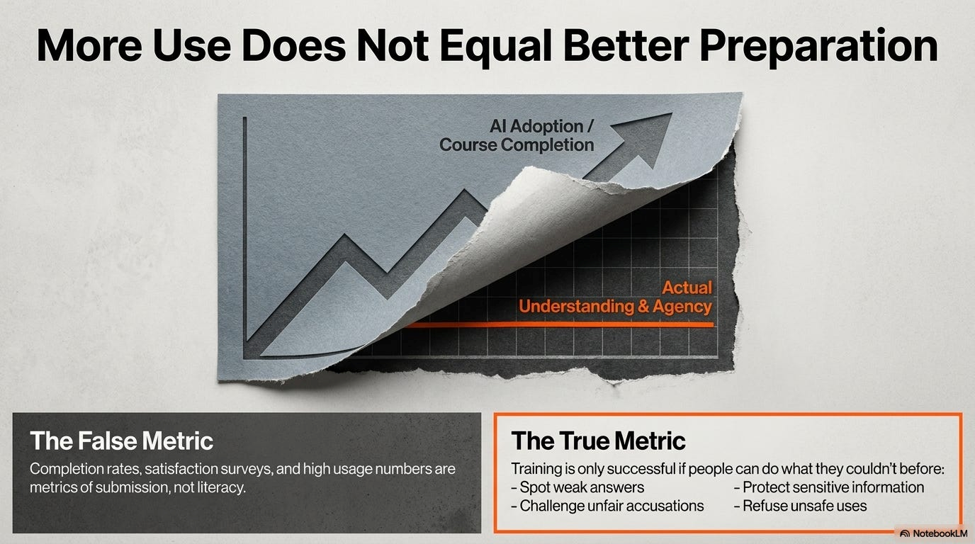
More Use Does Not Equal Better Preparation
AI training does more than teach skills. It tells people what they are expected to do once the tool arrives.
Some programs help people exercise professional judgment: when to trust a tool, when to override it, when to protect student or workplace data, and when a human decision has to come first. Others push people toward adoption: here is the tool, here is the workflow, here is how to use it more. Those two versions can look similar in a course catalog, but they serve very different interests.
The difference is a practical one, not philosophical. A teacher facing a suspected AI-written assignment does not need another slogan about innovation. A worker being told AI will save time needs to know whether saved time becomes relief, monitoring, or a higher output target. A community watching AI arrive in schools, services, or hiring needs a way to ask who chose the system and what choices are still open.
AI training should be judged by more than participation. Completion rates, satisfaction surveys, and usage numbers are easy to collect. They do not show whether people learned to spot a bad answer, protect sensitive information, challenge a wrong accusation, appeal a decision, or refuse an unsafe use.
Before an institution launches AI training, it should be clear about what people should be able to do afterward that they could not do before. If the answer is only “use AI more,” the training is adoption support. That may help the institution, but it is not enough for people whose grades, jobs, privacy, or local services are being changed by the rollout.
Better AI literacy would teach use and pushback together: use the tool when it helps, doubt weak answers, document high-stakes uses, escalate problems, refuse unsafe tasks, and ask who is accountable before the system becomes ordinary.
AI literacy should not end with the person being trained. If people are taught to spot weak answers, protect sensitive information, challenge unfair accusations, or refuse unsafe uses, the institution has to decide what happens when they do. Otherwise the training teaches judgment without giving that judgment anywhere to go.
Fluency is not enough. People need judgment, support, and a route to object before AI becomes the rule they are expected to live under.

Heath Dingwell is the Chief Implications Officer for Smarter Society AI. He moves fluidly between academic research, public health writing, and modern technological innovation. Heath has taught at several universities, and he writes on health and wellness for numerous health centers, including the Mayo Clinic. This is a series originally posted beginning on July 9, 2026 and is cross-posted here with permission. You can follow Heath here.
-------------------
Got something that needs to be heard? We'll get it said and read on the Worthy Educator blog! Email it to walter@theworthyeducator.com


Comments