

Mastering Self-Command: The First Job of Any Leader

One of the hard truths I’ve learned – both personally and through years of working with leaders – is this:
You cannot effectively lead others if you cannot first lead yourself.
You can have the right strategy, the right values, and the right goals but you are still going to have tough conversations and challenges you did not predict.
You and your team will face challenges. You will have disappointments and surprises.
And any time you walk into a situation in a triggered, limbic state (frustrated, anxious, defensive) you will almost always make things worse, because a leader, even a strong leader, stuck in survival mode tends to pour fuel on the fire.
A leader in Sage mode, however, can always be counted on to calm the storm.
In Conflict and Collaboration, I call the process of shifting from limbic to Sage – Self-Command.
Anyone can practice Self-Command; it’s not about suppressing emotions or pretending to be calm.
Self-Command is about learning how to notice your internal state, reset it, and choose your response on purpose.
Here’s how that works.
The Self-Commander:
A Three-Step Inner Process
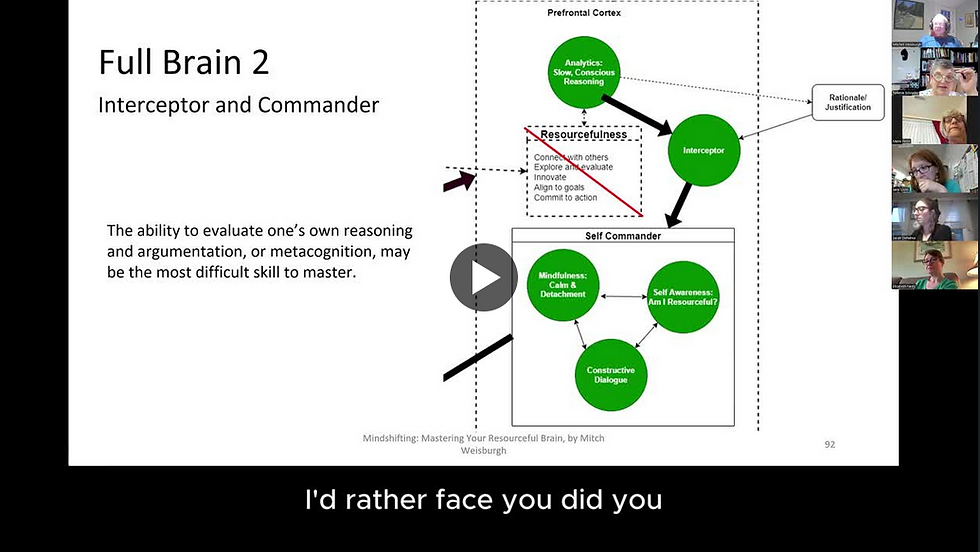
I think of the Self-Commander as a simple three-step sequence you can run in real time:
Self-Awareness
Finding Calm
Constructive Dialogue
It sounds simple. In practice, it’s one of the most advanced leadership skills you can learn.
Here is an intro to the Self-Commander from a recent MindShifting: Mastering Your Resourceful Brain course:
1. Self-Awareness: Catching Yourself in Limbic Mode
There is a reason that the first step is not “be calm” or “be wise.” It’s much more basic:
Notice that you’re triggered.
This is what I call The Interrupter—the moment you realize your survival brain has taken over. For me, it often shows up in my internal monologue. Thoughts like:
“I know what they should do.” (binary thinking)
“They’re challenging my authority.” (fight response)
“This is their fault.” (classic limbic blame)
“This is a personal attack.” (defensiveness)
“I should just stay quiet; saying anything will make it worse.” (freeze response)
“This is what everybody else is doing.” (mimicry response)
When I catch these thoughts, it’s my cue: I’m in limbic mode right now.
Sometimes that recognition is all I need to change course. Usually that recognition alone doesn’t fix anything—but it stops me from confusing a survival reaction with wise leadership. It gives me just enough space to move to step two.
2. Calm: Resetting the Survival Brain
Here’s the part many leaders get wrong:
You can’t reason yourself out of a triggered state, and you can’t order yourself out of one either.
When stress hormones like cortisol and adrenaline are flowing, your prefrontal cortex—the Sage part of your brain—is partially offline. Telling yourself “Calm down, this isn’t a big deal” is like giving a TED Talk to a fire alarm.
Instead, you need to distract and reset the limbic brain long enough for your Sage brain to come back online. Different techniques work for different people, but some reliable ones include:
Deep breathing or mindfulness for 2–5 minutes
Physical movement—a quick stretch, a walk down the hall, stepping outside
Changing your environment—leaving the room, getting some air, shifting posture
The goal is to adjust your composure, not to achieve perfect zen. It’s to lower the intensity of the limbic reaction so your Sage has room to operate. Once that intensity drops even a little, you’re ready for step three.
3. Constructive Dialogue: Activating Your Sage Mind
When the survival brain quiets, you can begin engaging your Sage mind on purpose.
Instead of judgmental, closed statements (“They’re wrong,” “This is ridiculous,” “I have to win this”), you start asking yourself curious, forward-looking questions, such as:
“What would I love to happen here?”
“How can I shift into exploration mode?”
“Which Sage power is most useful right now—Empathy, Exploration, Innovation, Navigation, or Focused Action?”
These questions do two things at once:
They pull you out of binary thinking.
They orient you toward possibility rather than threat.
From that place, you can walk into the conversation as a leader rather than as a combatant.

A Simple Practice: “Limbic or Sage?”
If you want to build your Self-Command muscles, start small.
One practical exercise I often suggest is to put a sticky note on your monitor, your notebook, or your phone that simply says:
“Limbic or Sage?”
When you feel yourself getting frustrated, defensive, anxious, or certain, pause and ask:
Am I in limbic mode right now?
Can I run the Self-Commander steps—Awareness, Calm, Constructive Questions?
No one is composed or calm all the time.
We are all human beings so the goal is not perfection. You will still get hooked. You will still react sometimes. But with practice, you’ll catch yourself earlier, reset faster, and enter difficult moments as the calmest person in the room.
Here is what one leader who took wrote:
The most valuable lesson I learned was the importance of self-awareness and emotional regulation in navigating disagreements. By recognizing when I’m in “limbic mode,” I can intentionally shift to “Sage mode,” which helps me remain calm, empathetic, and focused on understanding rather than reacting.
I think that recognizing the impact of limbic mode is important for me when entering into a conflict or argument. I feel arguments promote the escalation of fear, anxiety, or pain. I’m now more aware of the necessity to pause a few seconds and allow my prefrontal cortex to be more of an operating system. From there, I could activate my Sage mind through constructive dialogue.
And that’s where leadership really begins—not with managing others, but with mastering yourself.

Mitch Weisburgh is the master of MindShifting: how people can make decisions and act effectively, because, with the right mindset, anything is possible. He teaches educators how to be more resourceful, resilient, and collaborative so that both teachers and students can be more creative, collaborative, persistent critical thinkers and doers. This piece was originally posted on January 27, 2026 and is cross-posted here with permission. You can reach out to Mitch via email here.
-------------------
Got something that needs to be heard? We'll get it said and read on the Worthy Educator blog! Email it to walter@theworthyeducator.com


Comments