

Javeria Rana: When The World Becomes The Textbook: Rethinking Language Learning Through History, Art, and Cultural Memory
- 2 days ago
- 17 min read


"The world is not a collection of objects. It is a collection of stories."
—Adapted from the philosophical tradition of interpretation inspired by Hans-Georg Gadamer
Reading the World Before Reading the Word
What, exactly, counts as a text?
For centuries, education has answered this question with remarkable confidence. Texts have largely been understood as books, essays, manuscripts, newspapers, and, more recently, digital documents.
Classrooms have been organized around printed pages, and literacy has often been defined as the ability to decode, comprehend, and produce written language. These remain essential educational pursuits. Reading and writing are among humanity's greatest intellectual achievements, and no serious educator would argue otherwise.
Yet I have increasingly found myself wondering whether our understanding of literacy has become narrower than the world our students inhabit.
Every civilization has told its stories in multiple ways. Long before knowledge was systematically organized into textbooks, societies recorded their beliefs, aspirations, struggles, and achievements in architecture, monuments, paintings, songs, rituals, oral traditions, and public spaces. A cathedral, a temple, a mosque, a marketplace, a memorial, or even a city square can be read in much the same way as a written text. Each reflects decisions about identity, power, beauty, memory, and human experience.
Each invites interpretation. Each asks questions of those willing to observe carefully.
Perhaps one of the greatest limitations of contemporary education is not that students read too few books. It is that we have become exceptionally good at teaching them to read printed texts while giving far less attention to helping them read the world itself.
This idea resonates deeply with the work of Paulo Freire, who argued that authentic literacy extends beyond decoding words on a page. In The Importance of the Act of Reading, he famously wrote that reading the word should always be connected to reading the world. His insight remains profoundly relevant today. Language is never detached from the cultural, historical, and social realities that give it meaning. Words emerge from places, communities, traditions, and lived experiences. To teach language without context is to teach only part of the language itself.
This perspective invites us to reconsider one of the foundational assumptions of language education. What if authentic language learning does not begin with vocabulary lists or grammar exercises, but with meaningful encounters—with places that provoke questions, stories that awaken curiosity, and environments that invite learners to observe, interpret, discuss, and construct meaning together?
Such a shift does not diminish the importance of textbooks. Rather, it expands our understanding of what a text can be. A textbook remains an invaluable resource, but it is no longer the sole repository of knowledge. The world itself becomes part of the curriculum.
When students stand beneath the soaring arches of a centuries-old monument, examine inscriptions carved into stone, listen to oral histories preserved across generations, or observe the symbolism embedded within architecture and public rituals, they are engaging in acts of literacy that are every bit as complex as reading a printed page. They are interpreting evidence, constructing meaning, making cultural connections, and developing language through authentic encounters with the world around them.
Perhaps the question facing curriculum designers in the twenty-first century is no longer simply How do we teach students to read? It is becoming a far more profound question: “How do we Help Students Learn to Read the World?”

When Heritage Becomes Curriculum
One of the enduring challenges within Curriculum and Instruction is that learning is often compartmentalized into discrete subjects, each taught within the predictable boundaries of a classroom. History belongs to one period, language to another, geography to a third, and art is frequently treated as an enrichment activity rather than an intellectual discipline.
While such organization serves administrative convenience, it does not necessarily reflect how human beings construct understanding. Outside school, knowledge rarely presents itself in neatly separated categories.
Every meaningful experience demands that we draw simultaneously upon language, culture, history, observation, emotion, ethics, and critical thinking.
Historical places offer a compelling illustration of this interconnectedness.
They are not merely destinations to be visited or monuments to be admired. They are repositories of human experience, where architecture, language, politics, religion, geography, economics, and collective memory converge into a single educational encounter. In this sense, heritage sites function as what curriculum theorists might describe as multimodal texts—complex environments in which meaning is communicated not only through written language but also through symbols, visual design, spatial organization, artistic expression, and cultural practice.
For language educators, this presents a remarkable opportunity. Language is fundamentally more than vocabulary and grammar; it is the medium through which people interpret the world, negotiate meaning, and construct identity. When learners engage with places that embody centuries of cultural memory, they are not simply practicing language skills. They are using language for its highest purpose: to observe carefully, ask thoughtful questions, interpret evidence, describe experience, compare perspectives, and communicate ideas that emerge from authentic engagement with the world around them.
This understanding aligns closely with contemporary scholarship in place-based education, which argues that meaningful learning becomes more powerful when it is situated within the lived environments of learners rather than detached from them. Scholars such as David Sobel have long argued that local places provide rich contexts for inquiry, interdisciplinary learning, and civic engagement. Similarly, research in cultural literacy suggests that learners develop deeper comprehension when new language is connected to meaningful cultural experiences rather than isolated linguistic exercises. The classroom, therefore, need not end at its physical walls. Under thoughtful curriculum design, the wider community itself becomes an extension of the learning environment.
During recent visits to several historical sites across Pakistan, I found myself reflecting less as a tourist and more as an educator. I was struck not only by the architectural beauty of these places but by the extraordinary number of learning opportunities they quietly contained. Every inscription invited interpretation. Every corridor suggested historical narratives waiting to be explored. Every artistic detail raised questions about identity, craftsmanship, belief systems, and the civilizations that produced them. I began to wonder how differently students might experience language learning if these places were approached not simply as heritage destinations but as living classrooms.
A mosque can become a lesson in descriptive writing, persuasive speaking, historical inquiry, and intercultural dialogue. An ancient temple can invite comparative analysis, ethical discussion, and narrative interpretation. A salt mine can introduce scientific vocabulary, technical description, and environmental literacy. Even a national border ceremony can become an opportunity to examine rhetoric, symbolism, public performance, identity, diplomacy, and the language through which nations tell their own stories.
The educational possibilities are almost limitless—not because these places replace textbooks, but because they enrich them. They transform language from an abstract system of rules into a living instrument for understanding people, places, and civilizations. In doing so, they remind us that some of the most meaningful texts our students will ever encounter may never appear on a printed page. They are written instead in stone, preserved in architecture, echoed through traditions, and carried forward by the collective memory of communities.

Reading Living Texts: Four Lessons Beyond the Classroom
If we truly believe that literacy extends beyond printed pages, then we must also accept that every significant place possesses its own language. Architecture communicates values. Landscapes preserve memory. Public rituals express identity. Monuments tell stories about the civilizations that imagined and built them. These places do not speak through sentences, yet they remain remarkably eloquent for those who know how to observe carefully.
During recent visits to several historical and cultural landmarks across Pakistan, I found myself viewing these spaces less as destinations and more as texts awaiting interpretation. Each site seemed to ask different questions of its visitors. Rather than simply transmitting information, they invited reflection, dialogue, and inquiry. As an educator, I began imagining what might happen if students approached these places not as tourists collecting photographs but as researchers learning to interpret the world around them.
Reading History Through Architecture: The Badshahi Mosque
Standing within the vast courtyard of the Badshahi Mosque in Lahore, one is immediately struck by its scale and architectural harmony. Commissioned by the Mughal Emperor Aurangzeb in 1673, it remains one of the largest and most significant mosques in the world, representing the artistic and architectural achievements of the Mughal era. Yet beyond its historical significance, the mosque offers something equally valuable for education: it demonstrates that architecture itself can function as a language.

Its geometric precision, symmetrical design, intricate frescoes, marble inlay, and elegant calligraphy communicate ideas about beauty, faith, mathematics, craftsmanship, and cultural identity. Every arch, inscription, and decorative motif tells part of a larger story about the society that produced it.
For language learners, such a setting becomes an authentic context for observation, interpretation, and communication. Students can move beyond memorizing descriptive adjectives to using language purposefully—describing architectural features, interpreting symbolic meanings, comparing artistic traditions, debating preservation efforts, or reflecting on the relationship between faith and cultural heritage.
Grammar is no longer an isolated exercise; it becomes the tool through which learners articulate increasingly sophisticated observations.
Perhaps most importantly, students begin to understand that reading is not limited to decoding printed words. They learn to interpret visual texts, symbolic texts, and cultural texts with the same intellectual curiosity they bring to literature.
Reading Civilizations Through Cultural Memory: The Katas Raj Temples
Several hours from Lahore lies another remarkable educational
landscape: the Katas Raj Temples, a complex of ancient Hindu temples whose history extends over many centuries and whose cultural significance reaches far beyond national boundaries. Associated with traditions from the Mahabharata and revered by generations of pilgrims, the site reflects layers of religious belief, philosophical thought, artistic expression, and historical continuity.

What makes Katas Raj particularly valuable from a curricular perspective is that it challenges simplified narratives about culture and identity. Students encounter evidence of civilizations that have interacted, influenced one another, and coexisted across different historical periods. Such experiences encourage learners to move beyond viewing history as a sequence of isolated events and instead understand it as an ongoing dialogue between peoples, ideas, and traditions.
For language education, this creates rich opportunities for comparative writing, historical inquiry, intercultural dialogue, and reflective discussion. Learners might compare sacred spaces across cultures, analyze historical narratives from multiple perspectives, or examine how language shapes collective memory and cultural identity.
In increasingly multicultural and multilingual classrooms around the world, these conversations are not merely academically interesting; they are educationally essential. They help students develop empathy, perspective-taking, and the capacity to engage respectfully with histories and traditions different from their own.
Reading the Earth Through Human Ingenuity: The Khewra Salt Mines
The Khewra Salt Mines, among the oldest and largest salt mines in the world, tell a very different story. Their history stretches back more than two millennia and is often linked to the campaigns of Alexander the Great. Over centuries they have supplied one of the world's purest sources of rock salt while simultaneously illustrating humanity's ability to understand, adapt to, and work with the natural environment.
Unlike monuments built primarily for worship or governance, Khewra

demonstrates how landscapes themselves become texts that reveal the relationship between people, science, geography, industry, and economic development.
For educators, such places offer extraordinary interdisciplinary possibilities. Students encounter scientific vocabulary alongside historical narratives. They can explore geological processes, industrial heritage, environmental sustainability, descriptive language, technical writing, and problem-solving within a single learning experience. They learn that language is not merely for describing objects but for explaining systems, communicating evidence, and making sense of the physical world.
Experiences like these encourage students to see that science and language are not separate domains. They are complementary ways of understanding reality.
Reading Identity Through Public Ritual: The Wagah Border Ceremony
Few educational experiences demonstrate the power of symbols and public performance as vividly as the Wagah Border Ceremony between Pakistan
and India. Conducted daily at the international border near Lahore, the ceremony is characterized by synchronized military movements, ceremonial flag-lowering, patriotic music, and enthusiastic public participation. To many visitors, it is a memorable spectacle. To educators, however, it is also a remarkable opportunity to examine how nations communicate identity.
Public ceremonies function as powerful cultural texts. They employ gesture, choreography, language, symbolism, uniforms, music, and collective participation to express ideas about history, sovereignty, belonging, and national identity. Every element contributes to a carefully constructed narrative about how a nation understands itself.
For language learners, the educational possibilities extend far beyond observation. Students can analyze speeches and media coverage, compare national narratives, examine rhetorical devices, discuss diplomacy and conflict resolution, or reflect on how language both shapes and reflects collective identity. Such discussions

encourage critical literacy by inviting learners to ask not only what is being communicated, but also how, why, and from whose perspective.
Perhaps this is one of the most valuable lessons these places offer. They remind us that literacy is ultimately an act of interpretation. Whether students are reading a novel, a historical monument, a geological landscape, or a public ceremony, they are engaged in the same fundamental intellectual process: making meaning from the world around them.
From Reading Words to Reading Worlds
One of the unintended consequences of contemporary schooling is that literacy is often treated as synonymous with reading printed language. While reading and writing remain foundational, the demands of the twenty-first century require a broader understanding of what it means to be literate. Today's learners must interpret not only written texts but also images, environments, cultures, media, historical narratives, and increasingly complex social realities. In other words, they must learn to construct meaning across multiple contexts rather than within a single medium.
This shift has significant implications for Curriculum and Instruction. If education aims to prepare learners for a rapidly changing and interconnected world, then literacy itself must be reimagined as an interpretive practice rather than simply a linguistic one. Students should not leave school having mastered only the mechanics of reading; they should leave with the capacity to interpret the people, places, and cultures that shape human experience.
Reflecting on my own experiences of visiting historical and cultural landmarks, I began asking a simple question: What does an educator actually do when transforming a place into a learning experience? The answer, I realized, is not simply that students observe their surroundings.
Observation alone rarely leads to meaningful learning. Instead, effective place-based learning requires learners to move through a series of increasingly sophisticated acts of interpretation. They notice details, inquire into their significance, connect them with broader historical and cultural contexts, construct meaning collaboratively, and finally communicate their understanding through language.
From this reflection emerged what I have come to think of as The Place-Based Meaning-Making Cycle, a conceptual model that illustrates how authentic learning unfolds when historical and cultural environments become part of the curriculum.
The Place-Based Meaning-Making Cycle
Observe → Inquire → Interpret → Connect → Express
Each stage represents a distinct intellectual process.

Learners begin by observing carefully. They notice architectural forms, symbols, inscriptions, landscapes, artistic patterns, ceremonies, and human interactions that might otherwise go unnoticed.
Observation naturally gives rise to inquiry. Students begin asking questions about origins, purposes, beliefs, historical events, and cultural practices.
Rather than receiving information passively, they become investigators.
Inquiry then leads to interpretation. Learners examine evidence, compare perspectives, identify patterns, and develop increasingly nuanced explanations of what they have encountered.
Interpretation, however, becomes most meaningful when learners connect their observations to broader ideas. They relate local history to global history, cultural traditions to contemporary society, historical experiences to present-day challenges, and personal reflection to collective memory. Knowledge begins to form relationships rather than remaining isolated facts.
Finally, students express their understanding. They write reflective essays, participate in discussions, deliver presentations, create digital stories, produce visual representations, or engage in multilingual dialogue.
Language becomes not merely an object of study but the means through which meaning is constructed, negotiated, and shared.
What makes this cycle particularly powerful is that it reflects the way learning often occurs beyond formal schooling. Adults rarely encounter new ideas by memorizing disconnected information. We observe unfamiliar situations, ask questions, seek explanations, connect new experiences with existing knowledge, and communicate our understanding to others. In many respects, place-based learning mirrors the natural processes through which human beings have always learned.
Perhaps this is the deeper lesson historical places offer educators. Their greatest educational value lies not simply in the information they contain but in the habits of mind they cultivate. They invite learners to slow down, notice carefully, ask thoughtful questions, interpret responsibly, and communicate with greater depth and precision. These are not only language skills; they are habits of intellectual inquiry that remain valuable across every discipline and throughout a lifetime of learning.
Designing Classrooms That Extend Beyond Their Walls
Perhaps the greatest misconception about place-based learning is that it requires access to famous historical monuments or nationally recognized heritage sites. While places such as the Badshahi Mosque, the Katas Raj Temples, the Khewra Salt Mines, and the Wagah Border Ceremony offer exceptionally rich educational opportunities, the underlying philosophy of place-based learning is not dependent upon extraordinary locations. Rather, it depends upon an educator's willingness to recognize that every community contains meaningful texts waiting to be explored.

Every town has its own stories.
Every city possesses its own cultural memory.
Every neighborhood reflects histories, traditions, languages, and identities that deserve thoughtful attention within the curriculum.
For this reason, place-based learning should not be understood as an occasional educational excursion. It is better understood as a way of designing learning experiences that intentionally connect academic content with the environments students inhabit every day. Such an approach makes learning more authentic because it enables students to see that knowledge does not exist only within school walls. It exists within communities, public spaces, landscapes, local institutions, and the lived experiences of people around them.
For language educators, this shift can be remarkably transformative. A local marketplace may become a context for persuasive writing, observation, and intercultural communication. A museum can inspire narrative writing, historical inquiry, and descriptive language. Parks and natural reserves provide opportunities for environmental vocabulary, reflective journaling, and scientific explanation. Community libraries encourage information literacy, research skills, and critical evaluation of sources. Even public transportation systems, monuments, festivals, and neighborhood architecture can become catalysts for meaningful conversation, vocabulary development, collaborative inquiry, and authentic communication.
What changes is not merely the location of learning but its purpose. Language ceases to be an abstract system of grammatical rules and instead becomes a means of interpreting experience. Students begin using language because they have something worth communicating rather than because they have been instructed to complete another classroom exercise.
Educational leaders also play a critical role in making this vision possible. Schools committed to future-ready learning must move beyond viewing excursions, heritage visits, or community partnerships as enrichment activities that occur outside the curriculum. Instead, they should be intentionally embedded within curriculum planning, assessment design, and interdisciplinary learning experiences. This requires collaboration among teachers of language, history, geography, science, visual arts, and social studies, demonstrating to students that meaningful learning rarely respects the artificial boundaries created by school timetables.

The Five Principles
Several practical principles can help educators begin this work, regardless of where they teach:

Begin with the Local Before the Global
Students often develop stronger global understanding when they first learn to appreciate the histories and cultures immediately surrounding them. Every community offers opportunities to investigate language, heritage, identity, and change.

Design Questions Before Activities
Meaningful place-based learning begins not with a field trip but with thoughtful inquiry. Instead of asking, Where shall we take our students? educators might first ask, What questions do we want students to investigate? Powerful questions naturally transform places into learning environments.

Invite Students to Become Researchers
Encourage learners to interview community members, document local histories, photograph significant places, analyze public symbols, compare historical narratives, and present their findings through writing, discussion, digital storytelling, or multilingual presentations. Such experiences position students not simply as consumers of information but as producers of knowledge.

Integrate Disciplines Rather Than Isolate Them
A single heritage site can support objectives in language learning, history, geography, mathematics, visual arts, environmental studies, and citizenship education simultaneously. Interdisciplinary planning reflects the complexity of the real world more accurately than teaching each subject in isolation.

Encourage Reflection as Much as Observation
Visiting meaningful places is only the beginning of learning. Students require structured opportunities to reflect upon what they observed, how their thinking changed, which assumptions were challenged, and how the experience connects with broader social, cultural, or global issues. Reflection transforms experience into understanding.
Ultimately, the success of place-based learning depends less upon the significance of the destination than upon the quality of the questions students are invited to explore there. A world-famous monument and an ordinary neighborhood street can both become powerful classrooms when learners are encouraged to observe thoughtfully, inquire deeply, and construct meaning collaboratively. Future-ready education, therefore, is not defined by teaching in extraordinary places. It is defined by helping students recognize that every place has something important to teach.
The World Has Always Been a Library
There is a quiet irony in the history of education. We have invested enormous effort in teaching students how to read books, yet comparatively little in teaching them how to read the world those books attempt to describe. We celebrate literacy as one of humanity's greatest achievements, but too often we define literacy so narrowly that we confine it almost exclusively to printed words. In doing so, we risk overlooking the extraordinary richness of the world itself as a source of learning.
Perhaps the future of education requires us to recover an older understanding of what it means to learn. Long before the first modern school was established, people learned by observing the changing seasons, listening to oral traditions, interpreting symbols carved into stone, studying the architecture of sacred spaces, navigating rivers and mountains, participating in communal rituals, and preserving stories across generations. Knowledge has never resided only within books. It has always lived in landscapes, cultures, languages, and human experience.
This is not an argument against textbooks. On the contrary, thoughtfully written books remain among the most remarkable intellectual tools humanity has created. Rather, it is an invitation to place them within a larger educational ecosystem. A textbook can introduce an idea. A place can make that idea tangible. A classroom discussion can challenge assumptions. Reflection can transform experience into understanding. Together, these elements create learning that is intellectually rigorous, emotionally meaningful, and culturally grounded.
As educators, we often ask how we can make learning more engaging,
more authentic, and more relevant. Perhaps the answer begins with a different question. Instead of asking, How can we bring more learning into the classroom? we might ask, How can we help students recognize the learning that already exists beyond it? This subtle shift changes the role of education. The teacher is no longer the sole transmitter of knowledge but becomes a guide who helps learners notice, interpret, and make sense of the countless texts that surround them every day.
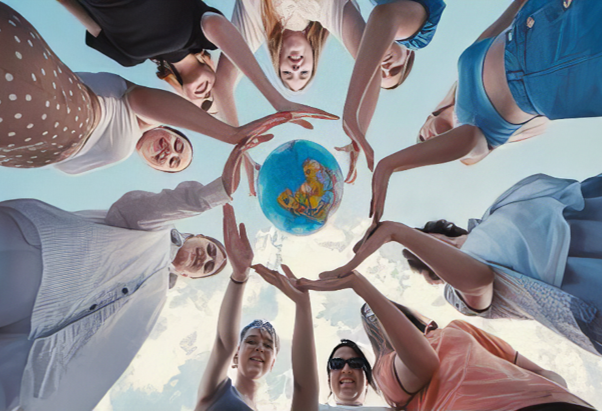
In an age increasingly shaped by artificial intelligence, this perspective becomes even more significant. Machines are becoming remarkably proficient at retrieving information, summarizing documents, and generating explanations. Yet no technology can stand in silent awe beneath a centuries-old monument, sense the atmosphere of a sacred place, engage thoughtfully with the memories of a local community, or appreciate the emotional resonance of a landscape that has witnessed generations of human history. These experiences require interpretation, empathy, imagination, and judgment—qualities that remain profoundly human.
For this reason, I believe the future of literacy extends beyond reading words with accuracy or producing grammatically correct sentences. Future-ready learners must also develop the capacity to read cultures with respect, histories with curiosity, landscapes with attentiveness, and communities with empathy. They must learn to ask not only What does this text say? but also Whose story does this place tell? What values does it preserve? What voices have been remembered, and which have been forgotten? These are the kinds of questions that cultivate not only stronger language learners but also more thoughtful citizens of the world.
Whether we teach in Lahore or London, Nairobi or New York, São Paulo or Seoul, every community offers its own living curriculum. Every city possesses places where history, language, identity, art, and memory intersect. Every educator has access to a world of texts that extend far beyond the printed page if only we are willing to recognize them.
Perhaps that is the most enduring lesson this journey has offered me. Standing beneath the domes of the Badshahi Mosque, walking through the ancient courtyards of the Katas Raj Temples, descending into the remarkable tunnels of the Khewra Salt Mines, and observing the powerful symbolism of the Wagah Border ceremony, I was reminded that these places were never merely destinations to visit. They were conversations waiting to be joined. They were classrooms without walls, where every stone, every inscription, every landscape, and every tradition invited deeper inquiry into what it means to be human.
If education is ultimately about helping learners understand both themselves and the world they inhabit, then perhaps we have been surrounded by textbooks all along.
We simply need to teach our students how to read them.


Future-Ready Schools is an exclusive feature by Javeria Rana on The Worthy Educator. Check back regularly for new insights on education transformed!



Comments